


Operating a modern water or desalination plant is demanding. Operators and maintenance teams must keep the plant producing the required amount of water, maintain equipment.
Why 90% Recovery Is the New Benchmark for UK Water Recycling
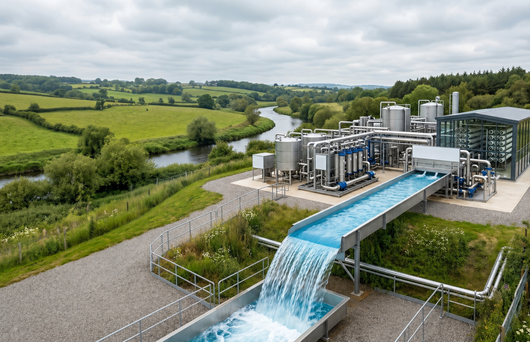
The UK water sector is entering a decisive decade. With supply–demand deficits forecast across multiple regions, tighter environmental abstraction limits and AMP8 placing renewed emphasis on resilience and efficiency, water recycling is moving from contingency planning to core strategy. Yet as schemes progress from concept to delivery, one issue consistently shapes viability: Residual liquid brine. The ability to reduce brine volumes is no longer a technical optimization. Sometimes, it is central to whether inland recycling projects can be delivered in a cost-efficient way.
The UK water sector is approaching a structural inflection point.
Water Resource Management Plans increasingly highlight a widening supply–demand gap. Rising population, more variable weather patterns, stricter environmental protections and limited abstraction headroom are placing pressure on existing water sources.
Water Resource Management Plans from UK water companies show a growing imbalance between future supply and demand, with a greater reliance on new sources such as recycling, desalination and reservoirs to meet needs out to 2050. The Environment Agency has emphasised that water recycling is needed to address pressures driven by population growth, climate change and drought resilience. Meanwhile, AMP8 is shaping up as a critical regulatory period focused on innovation, resilience and delivering new supply options alongside traditional approaches.
For many Water and Sewerage Companies (WaSCs), the question is no longer whether water recycling will form part of the long-term portfolio, but how quickly it can be deployed within AMP8 and subsequent regulatory periods.
Recycling treated effluent into a reliable resource reduces pressure on stressed catchments, supports drought resilience and aligns with the circular economy objectives embedded in UK infrastructure policy. However, as schemes move from feasibility studies to outline design, a persistent technical constraint emerges: Concentrate management.
Reverse Osmosis: Essential, Yet Historically Limited
Reverse osmosis (RO) is widely recognised as the primary barrier technology for advanced municipal recycling. It provides robust removal of dissolved salts, pathogens and emerging contaminants, including PFAS and other micropollutants of regulatory interest.
For indirect potable reuse and high-grade industrial supply, RO remains central to the treatment train.
Yet conventional RO systems typically operate at 75–80% recovery.
In practical terms, this means that 20–25% of the feedwater becomes concentrate (brine). For coastal desalination, this may be manageable. For inland UK recycling schemes, it can become the defining constraint.
Why Recovery Traditionally Stops at 80%
Two principal mechanisms limit recovery:
- Scaling: As recovery increases, sparingly soluble salts such as calcium carbonate, barium sulphate and silica reach supersaturation and precipitate onto membrane surfaces.
- Biofouling: Steady-state hydraulic conditions allow microbial communities to establish and grow, requiring chemical control strategies.
The operational consequence is increased cleaning frequency, membrane degradation and reduced asset longevity.
The UK Concentrate Challenge
Many AMP8 recycling schemes are located inland, discharging to environmentally sensitive river systems under Environment Agency consent.
Options for concentrate management typically include:
- Discharge to sewer (with associated charges)
- Tankering or off-site disposal
- Secondary brine treatment
Each introduces cost, permitting complexity and programme risk.
When 25% of treated volume becomes concentrate, disposal can represent a material proportion of lifecycle cost and regulatory exposure.
This is why recovery percentage is no longer simply a process metric, it is a viability determinant.
Redefining the Benchmark: Moving to 90% Recovery
High-recovery RO, targeting 90% and above, reframes the economics and environmental impact of recycling.
At 90% recovery:
- Product water increases without expanding abstraction.
- Concentrate volumes are halved relative to conventional systems
- Disposal infrastructure requirements are materially reduced.
Achieving this reliably, however, requires moving beyond the steady-state RO paradigm.
Pulse Flow RO: Engineering the Hydraulic Regime
IDE has been a global provider of desalination and advanced water treatment solutions for over six decades. For municipal water recycling, IDE’s focus is on achieving higher RO recovery with lower concentrate volumes. To achieve that, IDE’s approach centres on Pulse Flow Reverse Osmosis (PFRO), a departure from constant-pressure operation.
Unlike conventional systems, PFRO operates in rapid, controlled hydraulic pulses. Pressure and flow conditions are continuously varied rather than held constant.
Scaling is a time-dependent kinetic process. Crystal nucleation and growth require stable supersaturation conditions.
By dynamically altering the hydraulic environment, PFRO disrupts these conditions, preventing scale formation from stabilising on membrane surfaces. This enables operation at significantly higher recovery rates without inducing irreversible fouling.
The result:
- Up to 90% recovery in a single-stage configuration
- Reduced reliance on chemical antiscalant
- Stable long-term membrane performance
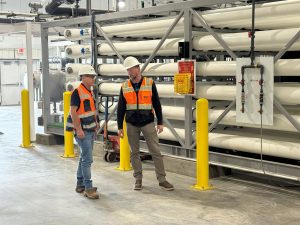
For UK sites, where space constraints at existing wastewater treatment works are common, achieving high recovery within a compact footprint is a critical design advantage.
Reducing Chemical Dependency
Conventional systems often rely on chloramines to manage biofouling. However, chloramine use carries the potential formation of disinfection byproducts such as NDMA, an emerging contaminant of global regulatory attention.
PFRO’s dynamic hydraulic regime suppresses biofilm establishment, reducing or eliminating the need for chloramines. This lowers chemical consumption and mitigates long-term compliance risk, particularly relevant for potable recycling schemes under increasing scrutiny.
Case Study: High-Recovery Recycling in Practice
A relevant municipal example is the Cherokee Metropolitan District, an inland utility near Colorado Springs. Cherokee faced a scenario familiar to many UK utilities:
- Increasing deman
- Limited groundwater availabilit
- No marine outfal
- Strict discharge constraints
Conventional RO would have generated significant brine volumes requiring complex and costly disposal strategies.
Instead, Cherokee implemented a high-recovery RO system using pulse-flow technology, achieving approximately 90% recovery in a municipal recycling application.
Outcomes Included:
- Significant reduction in concentrate volume
- Lower disposal requirement
- Smaller system footprint compared to multi-stage alternative
- Operational stability without heavy chloramine dependency
The recycled water supports aquifer recharge and long-term supply resilience.
For UK utilities evaluating inland recycling schemes, the parallels are clear: concentrate minimisation can determine whether a project remains theoretical or becomes deliverable.
Implications for UK Water and Sewerage Companies
TOTEX Efficiency
Higher recovery reduces:
- Feedwater abstraction requirement
- Intake and pre-treatment sizin
- Pumping energy per unit of product wate
- Concentrate handling infrastructure
Within Ofwat’s total expenditure (TOTEX) framework, the economic regulatory model governing UK water companies, these reductions support both capital efficiency and operational stability over the asset lifecycle.
Environmental Compliance
Reducing brine from 25% to 10% effectively cuts discharge volume.
For environmentally sensitive catchments, this:
- Simplifies EA permittin
- Reduces ecological ris
- Strengthens sustainability credentials within WRMP submissions
Future-Proofing Water Recycling for AMP8 and Beyond
As UK water companies advance recycling within their long-term supply strategies, resilience must be matched by efficiency.
High-recovery RO is not simply about increasing yield. It is about:
- Minimising waste stream
- Reducing regulatory exposur
- Lowering lifecycle cos
- Improving environmental performance
The 90% benchmark represents a recalibration of expectations. What was once considered an aggressive target is now operationally achievable at municipal scale.
For inland recycling schemes in particular, recovery rate directly influences deliverability.
Water recycling will be central to the UK’s resilience strategy over the next two decades. Technologies that reduce concentrate burden while maintaining process stability will define which projects progress from planning to commissioning.
The transition from 80% to 90% recovery may appear incremental. In practice, it fundamentally reshapes the economics, environmental impact and regulatory feasibility of municipal water recycling.


Roi Zaken Porat is a process engineer, team leader and R&D manager that has joined IDE Technologies in 2010. Roi has gained significant expertise in the field of RO and thermal desalination, nano-filtration and industrial wastewater management, and specializes in Zero Liquid Discharge solutions (ZLD), being actively involved with some of IDE's largest water treatment projects. Graduate of the Technion (Israel’s Institute of Technology), Roi holds a B.Sc. in Biochemical Engineering and an MBA from Tel Aviv University.


Don’t Miss Out on IDE’s Latest stories
Related posts
-


Digital Twin Development for Advanced and Optimized Water Operation & Maintenance
Read more -


High‑Recovery RO for Semiconductor Wastewater: Why Conventional Systems Fall Short, and What Comes Next
The semiconductor industry is undergoing a profound transformation. The rapid rise of AI, high‑bandwidth memory (HBM), and advanced logic nodes is driving unprecedented.
Read more


