


Operating a modern water or desalination plant is demanding. Operators and maintenance teams must keep the plant producing the required amount of water, maintain equipment.
Replenishing America’s Aquifers: Why Water Reuse Could Be the Solution
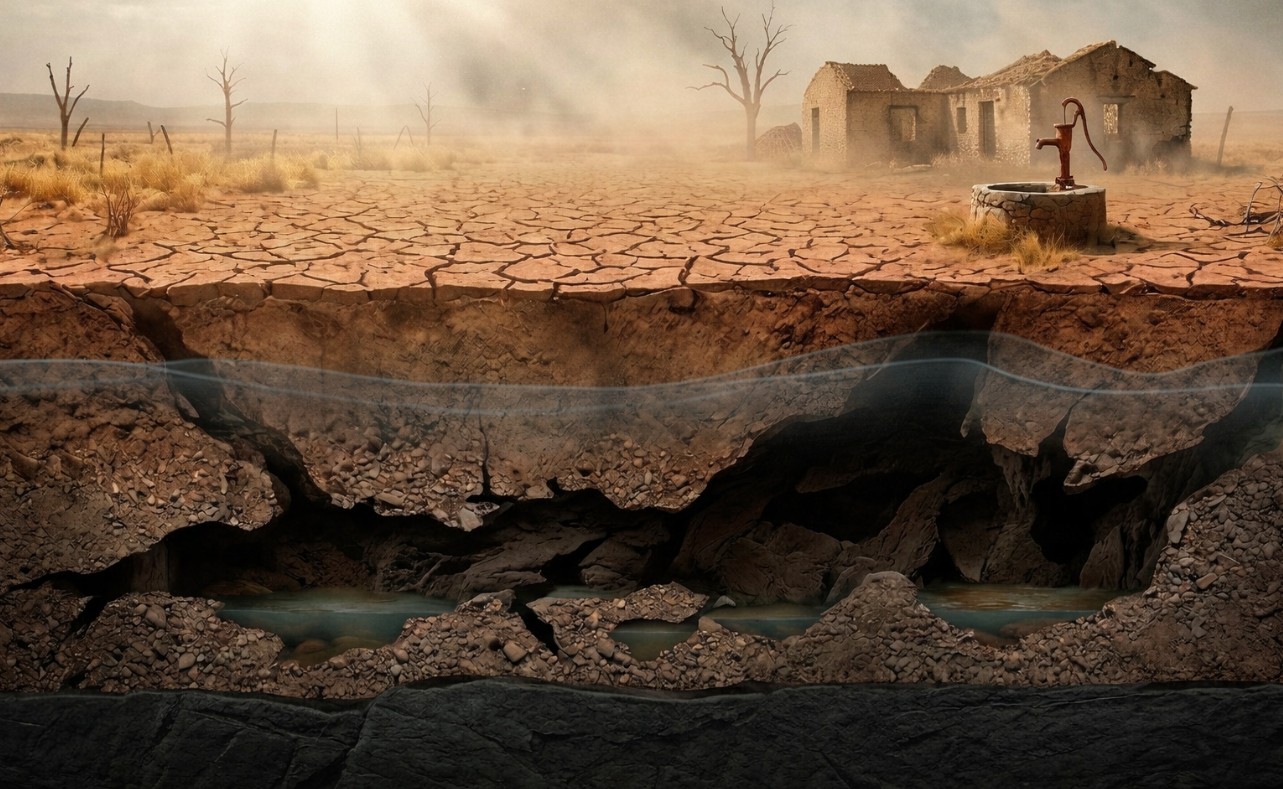
Groundwater depletion is no longer a distant environmental concern — it is a structural risk to water security, economic stability, and long-term resilience across the United States. As aquifers decline in basin after basin, conservation alone cannot restore what has been lost. Water reuse, particularly when paired with high-recovery treatment and managed aquifer recharge, offers a practical and scalable pathway to replenish the reserves beneath us. The question is not whether reuse works — it is whether we will deploy it at the speed this moment demands.
Across the United States, an invisible crisis is unfolding beneath our feet.
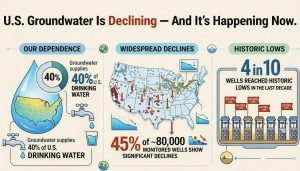
Groundwater supplies roughly 40% of U.S. drinking water and supports the reliability of water service for communities, agriculture, and industry. Yet groundwater levels are declining, and this is not a distant or historic trend. It is happening now.
A recent national review of monitored groundwater wells found that 45% of ~80,000 monitored wells have experienced significant water-level declines, with four out of ten reaching historic lows in the last decade.
Satellite data reinforce the warning. NASA analyses based on the GRACE/GRACE-FO satellite record show sustained groundwater losses across the American Southwest. In the Great Basin, NASA reports that the underground water supply has fallen by approximately 16.5 cubic miles (roughly 56 million acre-feet of water) over about the past two decades.
Regional studies further underscore that groundwater declines are widespread and persistent. A 2024 peer-reviewed geoscience analysis published in Nature found that rapid groundwater-level declines (> 0.5 m per year) are widespread in dry regions globally, including water-stressed areas with extensive cropland, illustrating that depletion trends have accelerated in many aquifer systems in recent decades.
This is not the result of a single drought year. It is structural.
Population growth in water-stressed regions has intensified withdrawals. Agricultural irrigation remains heavily groundwater-dependent in key basins. In coastal aquifers, declining pressure invites saltwater intrusion. In places such as California’s Central Valley and parts of Arizona, over-pumping has caused measurable land subsidence, reducing usable storage and increasing long-term risk.
Aquifers are long-term savings accounts. For decades, we have been withdrawing the principal rather than living off the interest.
Conservation remains essential. But conservation alone does not replenish depleted storage. If aquifers are to remain viable, engineered recharge and alternative supply strategies must become central to our water future.
Reuse: A Strategic Alternative Water Source
Water reuse is often framed as a sustainability initiative. In reality, it is far more than that. It is strategic infrastructure.
Treated municipal wastewater can be repurposed for agricultural irrigation, industrial processes, indirect potable reuse (IPR), direct potable reuse (DPR), and managed aquifer recharge (MAR). With modern membrane systems and multi-barrier treatment approaches, reclaimed water can consistently achieve high-quality standards suitable for these applications.
What makes reuse uniquely powerful is reliability.
Unlike rainfall, wastewater production remains steady, even during drought conditions. Communities generate wastewater every day. That makes reuse locally controlled and inherently resilient to hydrologic variability.
Reuse also reduces discharge pressures on receiving waters and can improve watershed health. But its most transformative impact lies underground; it enables intentional aquifer replenishment.
In a future defined by water stress, wastewater is the only water source that grows with population. That makes it not only sustainable, but strategically indispensable.
Closing the Loop: Replenishing Aquifers
Managed Aquifer Recharge allows highly treated reclaimed water to be returned to groundwater basins through infiltration basins or injection wells. Instead of discharging advanced-treated effluent downstream, communities can redirect it into the aquifers that have been overdrawn.
This approach offers multiple advantages:
- Restored groundwater levels
- Reduced land subsidence
- Protection against seawater intrusion
- Underground storage without evaporation loss
- Increased long-term water banking capacity
Aquifers are vast natural storage systems. Replenishing them strengthens resilience without requiring new surface reservoirs. In regions facing chronic groundwater decline, reuse provides a practical and scalable stabilization pathway.
Importantly, this is not theoretical. It is already working.
Cherokee Metropolitan District: Where Compliance Meets Aquifer Stewardship
In Colorado, the Cherokee Metropolitan District (CMD) shows how a modern water infrastructure facility can be more than compliant. It can be a true steward of the aquifer and the environment it serves.
Cherokee’s 4.8 MGD wastewater treatment plant discharges into a groundwater basin. A new, highly restrictive discharge permit required that final effluent Total Dissolved Solids (TDS) be reduced to below 400 mg/L before recharge to the aquifer. Recharge was not optional, it was mandated. The challenge was how to meet this requirement in a way that minimized waste, controlled scaling risk, and ensured long-term operational stability.
To address this, Cherokee implemented a High-Recovery Reverse Osmosis (HRRO) system using IDE’s Pulse Flow Reverse Osmosis (PFRO) technology.
PFRO is designed to maximize recovery without pushing membranes to the point where scaling and fouling take over. Instead of running at one steady condition, it operates in short cycles that periodically “flush” concentrated brine out of the system, helping keep the membranes cleaner and performance stable. That cycling is what enables very high recovery, of 90–95%, in a compact design.
By implementing IDE’s high-recovery PFRO, Cherokee transformed a regulatory obligation into a long-term groundwater stabilization strategy, demonstrating that wastewater treatment can actively restore the resources communities depend on.
Watch the Cherokee story:
The Economics of Inaction
The cost of aquifer depletion is rarely fully calculated.
Declining groundwater increases pumping depth and energy consumption. Land subsidence damages roads, pipelines, and foundations. Agricultural yield variability increases. Municipal growth becomes constrained by supply uncertainty. Industries that require reliable water, from food processing to advanced manufacturing, face heightened operational risk. Water scarcity is not a distant environmental forecast. It is a present-day business continuity issue.
Reuse offers a different trajectory. By stabilizing groundwater levels and diversifying supply portfolios, communities reduce long-term risk exposure. Investments in reuse infrastructure are investments in resilience, protecting water systems and the economies they support.
Policy Momentum and Public Trust
Regulatory frameworks are evolving alongside technological capability. In 2023, California finalized its regulations for Direct Potable Reuse (DPR), becoming one of the first U.S. states to formally authorize purified wastewater as a drinking water source under a structured regulatory framework. At the federal level, the Infrastructure Investment and Jobs Act (IIJA) allocates billions of dollars toward water infrastructure, including funding through the State Revolving Funds (SRFs) and the Water Infrastructure Finance and Innovation Act (WIFIA) program to support advanced treatment, reuse, and resilience projects.
Meanwhile, groundwater management requirements are tightening across multiple regions. California’s Sustainable Groundwater Management Act (SGMA) is now moving from planning to enforcement, requiring basins to demonstrate measurable progress toward sustainable yield. Similar groundwater oversight measures are expanding in states such as Arizona and Texas, where long-term aquifer declines have intensified policy responses.
Technology is no longer the limiting factor. The policy landscape is increasingly aligned with the need for resilient, diversified water supply portfolios.
Replenishing What We Have Depleted
We cannot drill our way to sustainability. We cannot conserve our way out of structural groundwater decline. Conservation slows depletion, but it does not restore storage that has already been lost.
Reuse does.
By capturing, treating, and returning water to the aquifers that sustain us, communities transform wastewater from a liability into a strategic asset. They stabilize supply, protect underground reserves, and build resilience against climate uncertainty.
The most reliable new water source in America is not hidden in a distant watershed. It is already flowing through our communities every day.
The question is not whether reuse can replenish aquifers. The question is whether we will act with the urgency that this moment requires and replenish the underground reserves that have quietly sustained us for generations.
Contact a water expert today and find out more about how IDE can help you solve your water challenges.

Rosemary Niechcial is the Chief Executive Officer of IDE Water Solutions N.A. Inc., the North America subsidiary of IDE Technologies. With more than two decades of leadership experience in the water treatment industry, she is responsible for driving IDE’s growth across municipal and industrial markets in the region, with a focus on advancing innovative, sustainable solutions to address today’s most pressing water challenges.
Throughout her career, Rosemary has built a strong track record in sectors central to IDE’s business, including mining and energy, as well as extensive expertise in critical water infrastructure and Public-Private Partnerships (PPPs). She has successfully developed teams and forged strategic partnerships across the Americas, Asia, Europe, Africa, and Australia.
Before joining IDE, Rosemary held senior leadership roles at Baker Hughes, Black & Veatch, and Veolia Water Solutions & Technologies, where she led large-scale projects and business development initiatives. At IDE, she is leading efforts to expand the company’s solutions to meet emerging regulatory demands, such as PFAS treatment, while accelerating progress toward long-term sustainability goals.
Passionate about safeguarding the world’s most precious resource, Rosemary is committed to ensuring reliable access to clean, high-quality water and helping IDE’s customers secure resilient water solutions for the future.


Don’t Miss Out on IDE’s Latest stories
Related posts
-


Digital Twin Development for Advanced and Optimized Water Operation & Maintenance
Read more -


High‑Recovery RO for Semiconductor Wastewater: Why Conventional Systems Fall Short, and What Comes Next
The semiconductor industry is undergoing a profound transformation. The rapid rise of AI, high‑bandwidth memory (HBM), and advanced logic nodes is driving unprecedented.
Read more


